
Eau Claire - From SawMill to Skyline
This was the Eau Claire – from Sawmill to Skyline Jane’s Walk on May 2, 2026. Feel free to use it as a self-guided tour.
Jane’s Walk is a global festival that was started in Toronto in 2007 by friends of Jane Jacobs, to honour her legacy as a writer & activist who changed the way people think about cities. One of her greatest contributions was to highlight the role of ordinary citizens in the ongoing evolution of their cities.
Jane’s Walk is now a global phenomenon – with more than 200 cities around the world holding Jane’s Walks this weekend, from Istanbul, Turkey to Montevideo, Uruguay to Calgary, Alberta. We have 145 walks over these three days, and our festival is organized by the Federation of Calgary Communities, who do great work year-round assisting community associations and hosting events.
Before we begin, I’d like to acknowledge Robert Craig and William McLennon, who both grew up in the neighbourhood they used to call U Claire. William wrote a book called 711 Eau Claire Avenue, and Robert wrote an article for our Newsletter back in 2018, and all of the intimate, domestic details I’ll mention today come from those two sources. The Glenbow Archives and the Calgary Herald are the sources for most of the rest of the historical portion of this talk.
You are participating in this walk at your own risk. Please obey all traffic signs & regulations and keep yourself and each other safe. And please do not walk beyond your limits; you can leave the walk at any time. Just let us know. While we will be strolling and stopping throughout the neighbourhood, we will never be more than 10 minutes brisk walk from this location.
MEETING PLACE / STOP ONE – EAU CLAIRE AND BOW RIVER LUMBER COMPANY
Being this close to downtown, there has always been a push/pull between residential and commercial development in this neighbourhood, so it’s hardly a surprise that we owe our name to the first large commercial development and the workers who settled around it.
The Eau Claire and Bow River Lumber Company was chartered by the state of Wisconsin in 1883 to exploit the timber rights on 100 square miles (260 sq km) around the Bow, Kananaskis and Spray Rivers.
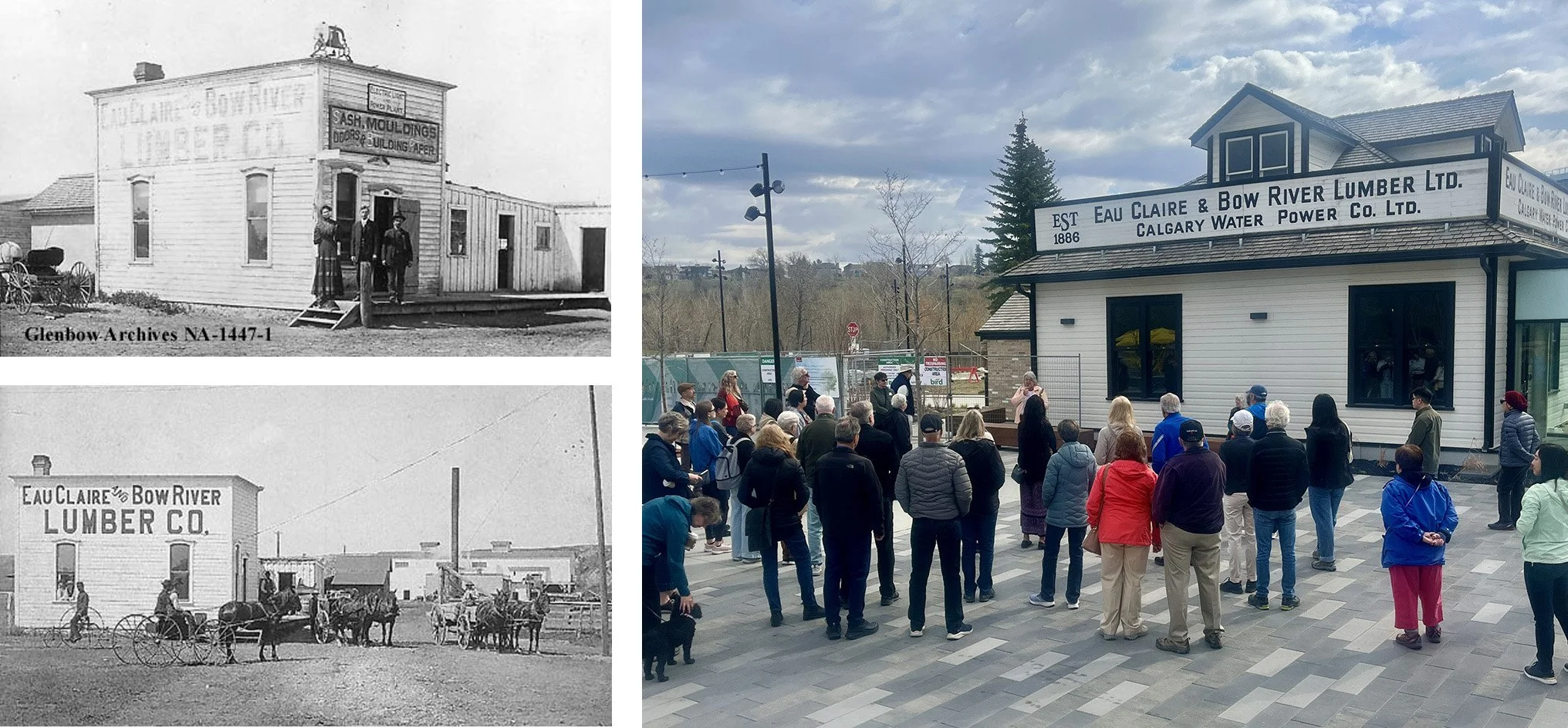
The first act of business was to dismantle a complete sawmill at Eau Claire, Wisconsin and ship it to Calgary, complete with a predominantly Norwegian crew of skilled workmen with experience developing new lands. Because the rail lines didn’t match, the workers spent a full week manually transferring the heavy machinery and all goods from the American tracks onto the CPR tracks at Winnipeg.
They arrived here on June 6, 1886 and worked long hours all summer and fall to build the mill and to install the machinery.
The mill was set up in Calgary, and two logging camps were established, one on the Kananaskis and one on the Bow at Silver City west of Banff. Timber was cut every winter, floated to Calgary in spring, and sawed into lumber in summer and fall. This was one of Calgary's major industries, which would soon turn out three carloads of lumber daily, not only for Calgary, but for the surrounding territory some 100 miles in every direction.
The Norwegians who came west at that time settled in newly built cottages on streets adjacent to the mill, forming the Eau Claire district.
The Operations Manager, Peter Prince, was an enterprising guy who created an island from a peninsula by digging out the land and allowing the logs to float right up to the sawmill. He also formed the Calgary Water Power Company in 1890, built a dam on the Bow River to harness hydroelectricity, and later became involved in other business ventures in Calgary, including a flour mill, a meat-packing plant, grain elevators and a brewery.
BE CAREFUL CROSSING THE BIKE PATH; LOOK BOTH WAYS AND GO WHEN SAFE
STOP TWO – RIVER OUTLOOK
This viewing platform is a new addition to the neighbourhood and strikes me as the place to stop and imagine the interactions this river has had with humans over millennia.
We acknowledge the traditional territories and oral practices of the Blackfoot (Siksika, Piikani, and Kainai), the Tsuut’ina (Sarcee), the Stoney Nakoda First Nations, the Métis Nation (Region 3), and all people who make their homes in the Treaty 7 region of Southern Alberta.
First Nations used the Bow River as a vital resource for travel, trading, and sustenance, with the confluence – about 2 km down this pathway -- where the Bow and Elbow Rivers meet serving as a neutral site for trade, ceremonies, and, in 1877, the signing of Treaty 7.
The river provided essential resources, with reeds used for bows (giving the river its name), relatively sheltered banks for winter camping, and hunting grounds for buffalo. It was also a natural corridor for movement across the prairies.
The Bow River remains deeply significant to the Treaty 7 Nations and the Métis Nation in the region, connecting their history, spirituality, and culture to this land.
STOP THREE – JAIPUR BRIDGE
Who can tell me why this is called the Jaipur Bridge?
The City of Calgary has six official sister city relationships focused on international cooperation, economic development, and cultural exchange.
Can anyone name our six sister cities?
Daejeon, South Korea (since 1996)
Daqing, China (since 1981)
Jaipur, India (since 1973)
Naucalpan, Mexico (since 1994)
Phoenix, United States (since 1997)
Quebec City, Canada (since 1956)
These relationships are managed by the City of Calgary to foster mutual benefits in business, education, and culture. For example, the Daqing relationship focuses on energy, while Jaipur focuses on manufacturing.
STOP FOUR – PROMENADE SLIGHTLY WEST OF JAIPUR BRIDGE
We can’t walk along the Bow River without talking about flooding
• Calgary has a long history of major flooding, with significant events occurring in 1879, 1897, 1902, 1915, 1929, 1932, 2005, and most notably, 2013. The 2013 flood forced over 80,000 evacuations and caused widespread damage. Total economic loss has been estimated between $5 and $6 billion! There was one death in Calgary and four in High River.
• The silver lining of this terrible event was the way everyone stepped in to help. The city asked for 500 volunteers to show up at McMahon Stadium, and thousands showed up. The city just said, “We can’t manage this many people, spread out into the neighbourhoods and help anyone you can.”
• People went into homes to pull out water-damaged belongings, flooring and drywall. Volunteers hauled loads to the dump while other volunteers delivered water, coffee and sandwiches. Calgary’s annual Neighbours’ Day was created to honour that proof of the best of humanity.
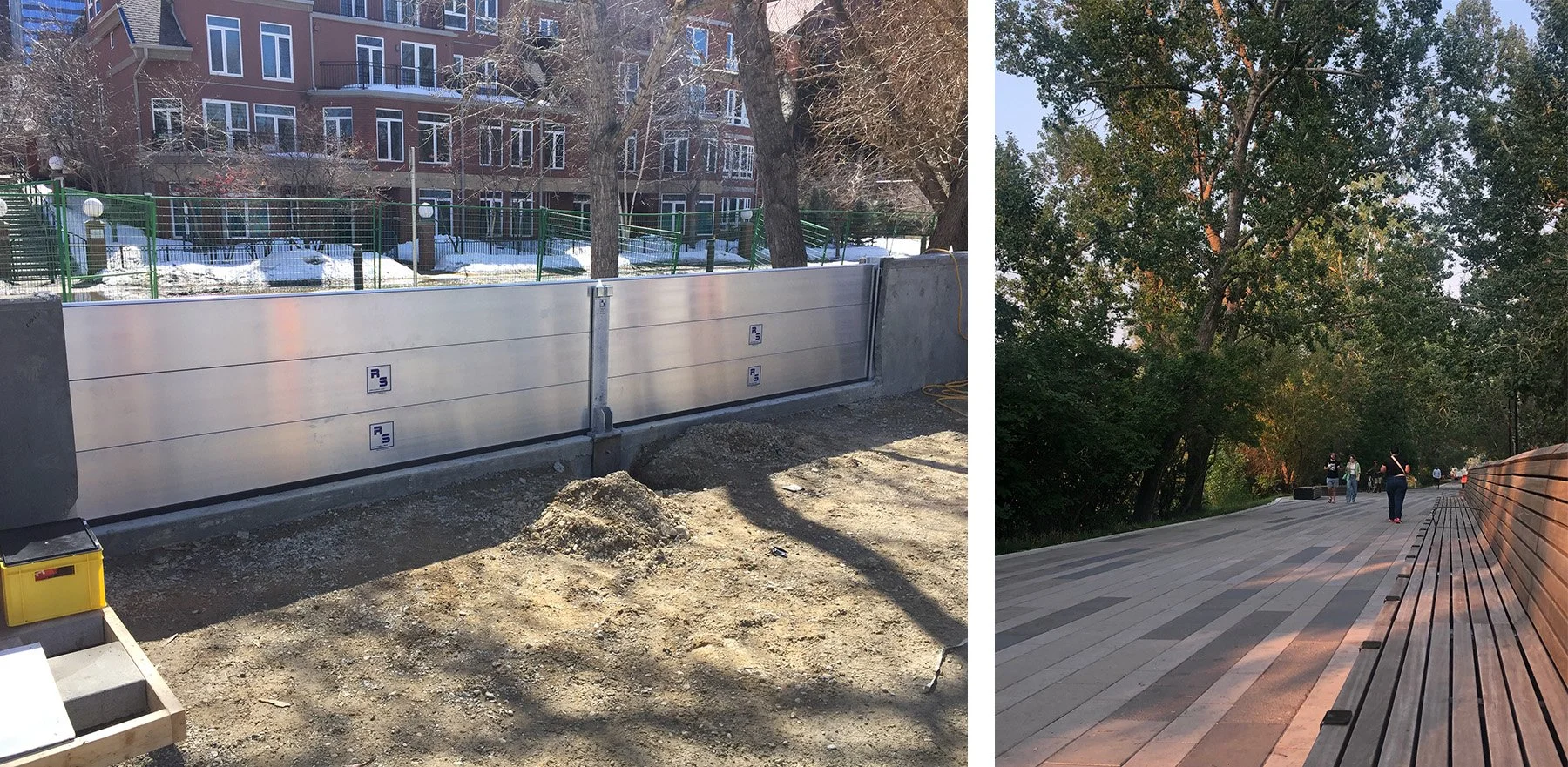
• Since then, the city & provincial governments have invested hundreds of millions of dollars in flood mitigation projects, including raising the riverbank by as much as 1.5 meters along this corridor. The beautiful promenade we’re standing on is part of that.
o The seating clads concrete walls designed to hold back the river in case of a 1:200 year flood.
o Hidden underneath the seats are metal panels, which will be quickly installed across all of the gaps in the walls if flooding is imminent.
We’ve heard about the best of humanity, and we’re witnessing how beautiful flood mitigation can be – now let’s imagine dystopia for a minute: in the 1940s, the CPR proposed running railway tracks along the south bank of the Bow River.
Can you imagine smelly, noisy, dangerous train tracks separating downtown from the river?
Fortunately, a man named Jack Leslie led the fight against the plan and won the two-year battle. Serving on the Land Committee, he also persuaded the City to purchase Bow riverbank property as it became available.
In 1947, the City of Calgary purchased the land from the Prince family and created a park. Today, Prince’s Island is one of the premier urban parks in North America.
In 1965, Jack became the first native-born mayor of Calgary. 1966 One of his first projects was building a walking trail linking the Calgary Zoo with Shouldice Park - the beginning of Calgary's extensive parkway path system. Today, Calgary has the most extensive urban pathway and bikeway network in North America. The City of Calgary maintains approximately 580 km of regional pathways, 220 km of local pathways and 95 km of trails. Enough to stretch to Saskatoon.
Jack Leslie was an influential environmentalist, and he worked to maintain the beauty of the Bow River’s edge and began the process of making Prince’s Island Park the jewel it is now. The City of Calgary created the Jack Leslie Youth Environmental Grant in 2004, which supports youth-led projects that protect and improve Calgary’s natural environment.
Walk down the Promenade and turn left past 500 Eau Claire Estates.
BE CAREFUL CROSSING THE BIKE PATH; LOOK BOTH WAYS AND GO WHEN SAFE; PEDESTRIANS HAVE A YIELD SIGN
STOP FIVE – 5TH STREET AND EAU CLAIRE AVENUE
In the 1940’s and 50’s this was the site of the Buffalo Stadium. Wartime baseball games would attract 3,000 to 4,000 spectators. These photos are from the Glenbow Archives – look at how formally they are dressed! Another cool thing we can see in the background are the homes in what was then a normal family neighbourhood.
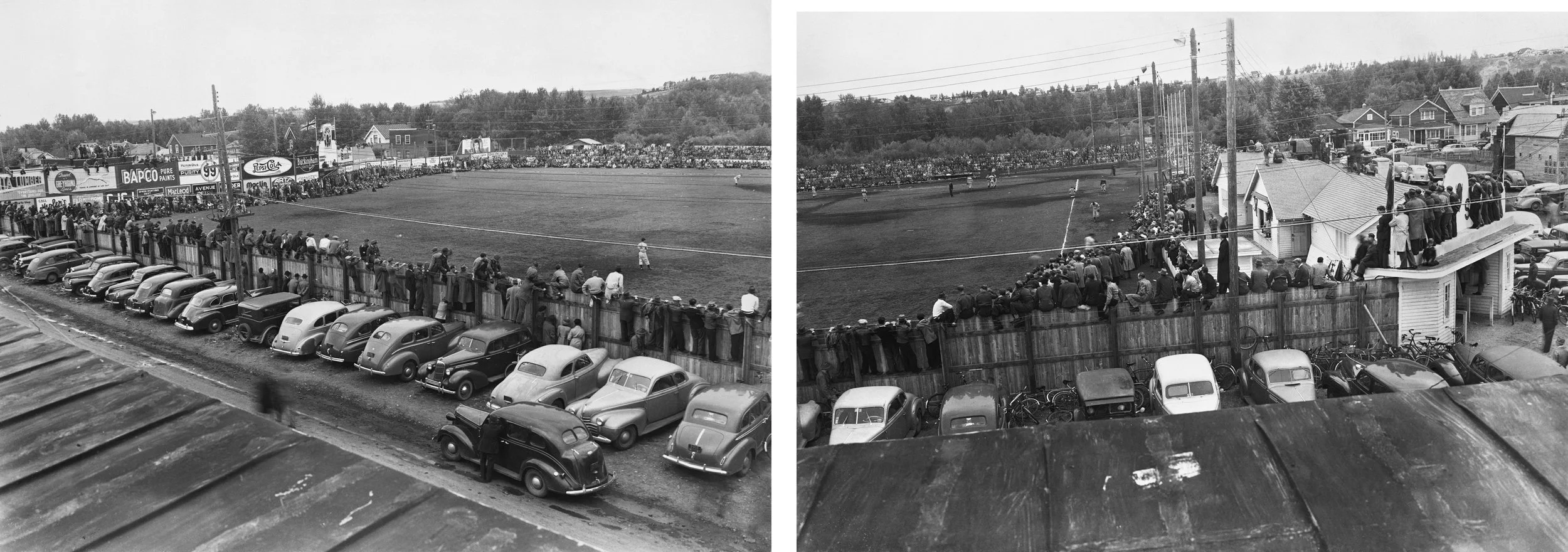
In the winter there were three ice rinks over this same area and William McLennan said, "Hockey kept me out of reform school and helped me get my education." He went to Michigan State University on a hockey scholarship. The Buffalo Athletic Association Hockey League was also the first home for at least three future NHLers
Frank McCool (goalie for the Leafs),
Hank Bassen (goalie for the Blackhawks) and
Ron Stewart (Right-winger who won the Cup 3 times with Toronto from 1962 to ’64)
Of all the amazing things I learned researching this tour, the fact that the Leafs were a dynasty team in the 60’s was the biggest surprise!
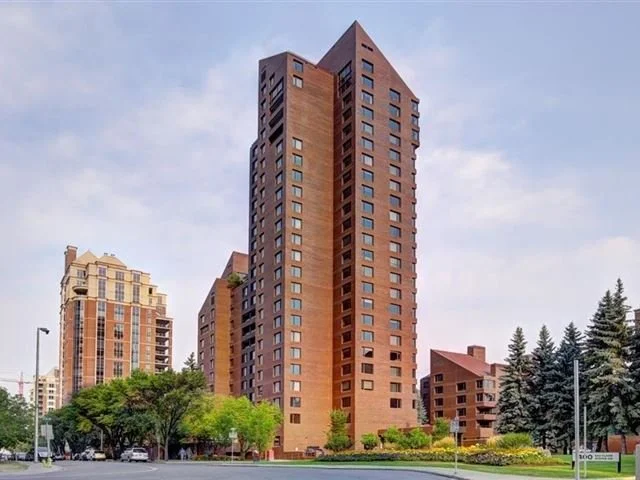
Jump forward in time and in the late ‘70’s driving into downtown over the Louise Bridge this was a desolate land of gas stations, parking lots and squat low-rise office buildings without personality or style. Then Eau Claire Estates arrived in 1981. It was designed by Chicago-based Skidmore Owings & Merrill architects, renowned high-rise specialists since 1936. Today, SOM is best known as the architect of one of world’s tallest building - Burj Khalifa tower in Dubai.
Eau Claire Estates has hints of modernism with the various slanted rooftops that anticipate the roofs of future office buildings like First Canadian Place and Suncor Centre. It was one of city’s first luxury urban condos. Though it was supposed to be the start of a mega Eau Claire urban renewal project, it sat all alone for nearly a decade.
It wasn’t until the mid ‘90s that Eau Claire’s revitalization was rebooted with the opening of Eau Claire Market, Eau Claire YMCA, Sheraton Eau Claire Hotel and Prince’s Island Estates condos. But it took another 10 years to get projects like the Princeton Grand and The Princeton Hall condos off the ground.
STOP SIX - Joe Phillips Building - The Commercial and Industrial District
In the first half of the last century, the neighbourhood was truly mixed with many businesses and factories as well as workers' homes, some of which were far from humble – Prince’s House & Thorpe House now stand in Heritage Park and are quite grand.
This is the last commercial building from that era that remains. It demonstrates the importance of Calgary-based business to the development of agriculture in Western Canada. The structure was completed in 1911 and owned by a group of businessmen.
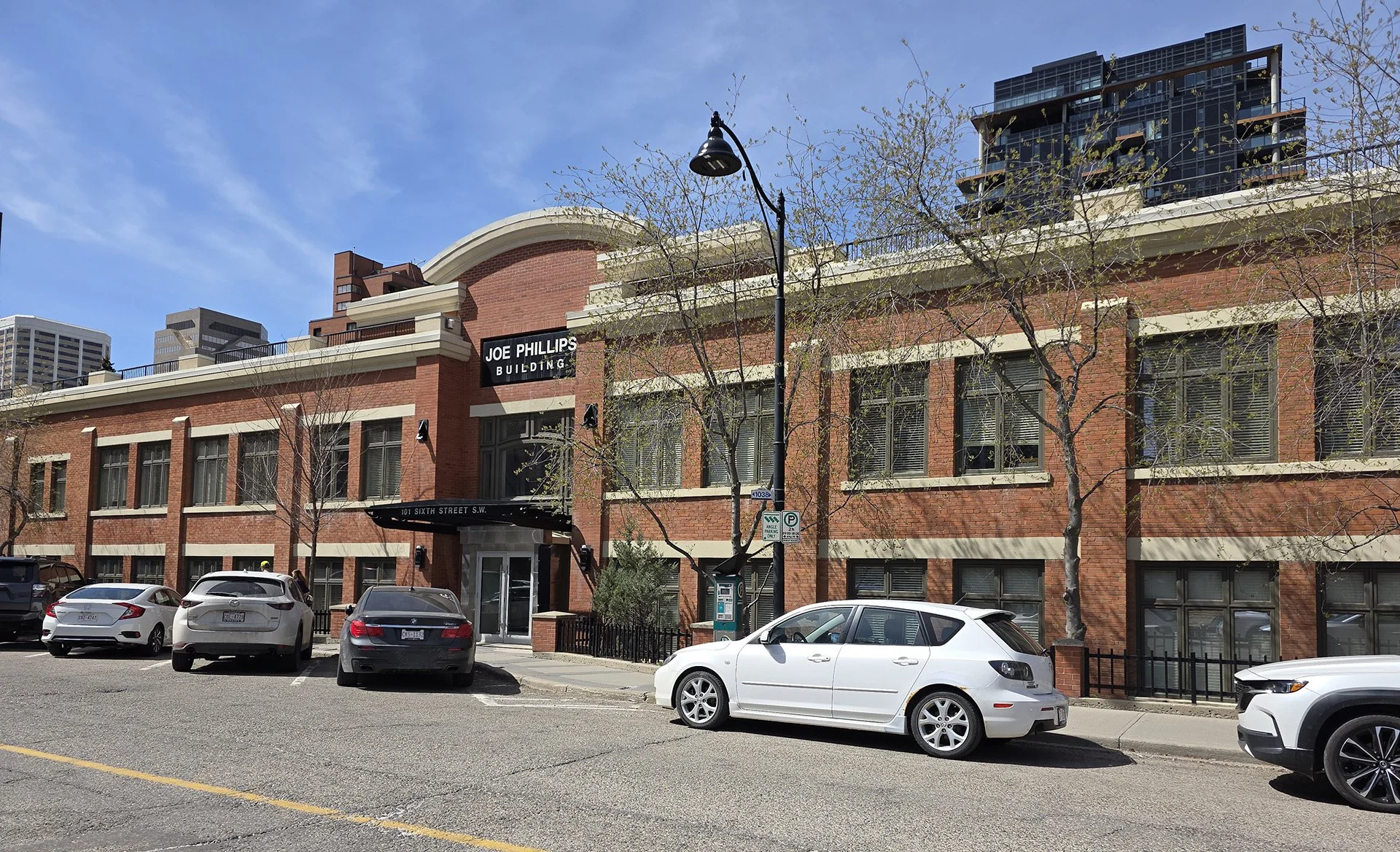
The early uses of this building included offices for the many enterprises of the partners, which ranged from farming and real estate development to printing and publishing, including the popular Western Agriculture newspaper. Publishing was so important that by 1917, the name of the building was changed to The Graphic Arts Building. In about 1965, it was purchased by Joe Phillips, who was the founder of the PBA Group of companies, which are still developing real estate in Calgary today. They are the firm behind the Element by Westin, The Dorian and The Courtyard, all three of which are easy walking distance from here.
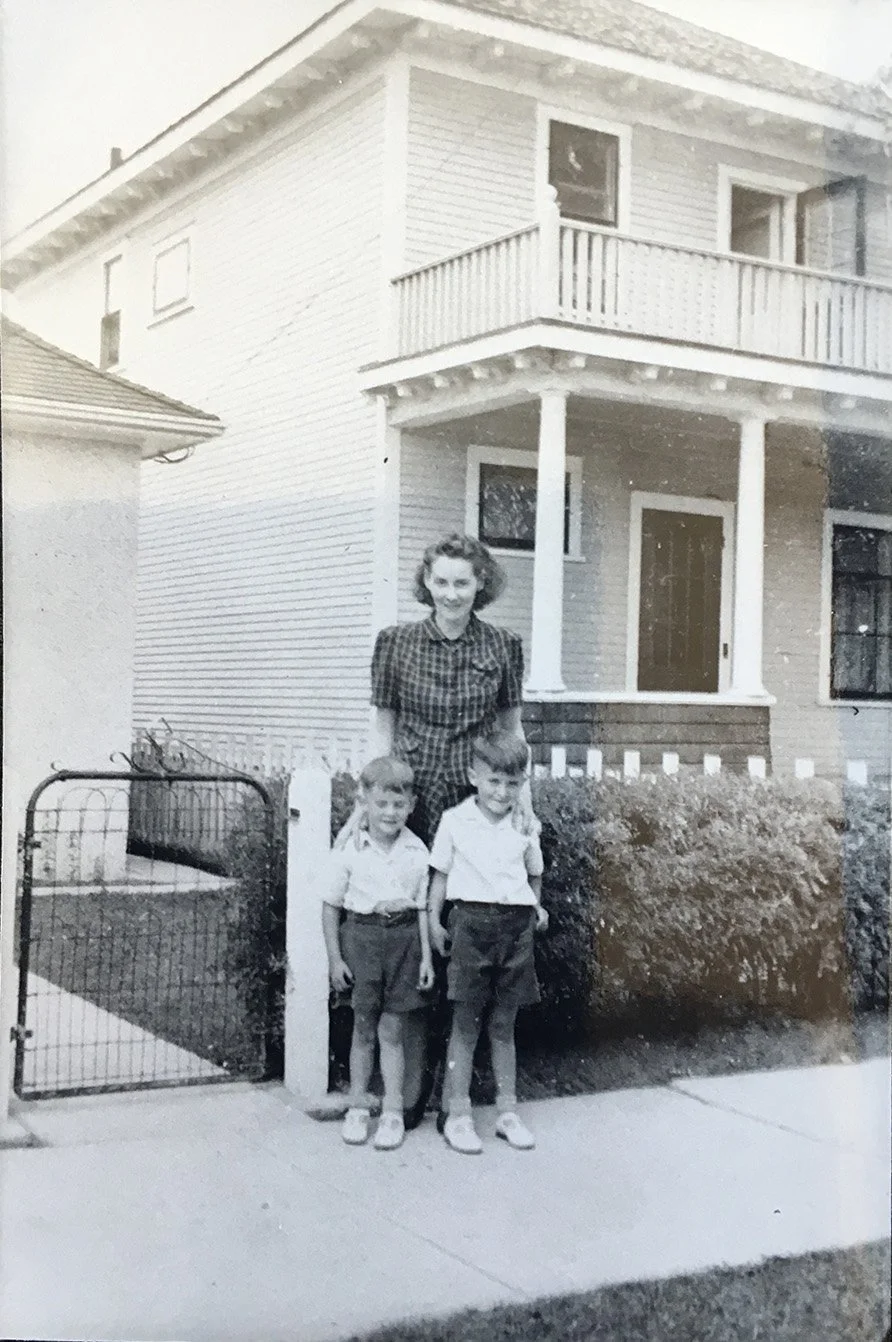
This photo is of Betty McCaul in front of 523 – 1st Ave and was provided by Robert Craig. Some of the memories of the kids growing up here in those days include:
Young McLennan and his friends would tentatively explore the silent structure that had been the power plant, creep nervously past the Alberta Casket Company, or watch the presses run here at Western Printers.
Robert Craig’s first paying job, in grade one or two, was using his wagon to collect old newspapers and sell them for pennies a pound to the local coffin maker for lining caskets.
Both men remember running logs on the log boom or playing in the lumber stacks – they’d get punished if they were caught, but the fun was worth the risk.
They both mention the sounds you could hear:
The noon whistles -- "From one side, you'd hear the dairy whistle, from the other, the sawmill."
The clop-clop in the street as horse-drawn wagons and carts delivered bread, produce, milk, laundry and ice.
We suggest you try to imagine this area as it was then: the roaming bands of kids exploring; the factory workers (many of them women during the war years); the delivery carts; even the casket maker as you walk to your next stop.
We had such a large group on the Jane’s Walk that I had to cut this section of the tour out. But if you have the time, walk north on 7th Street to get back on the Promenade.
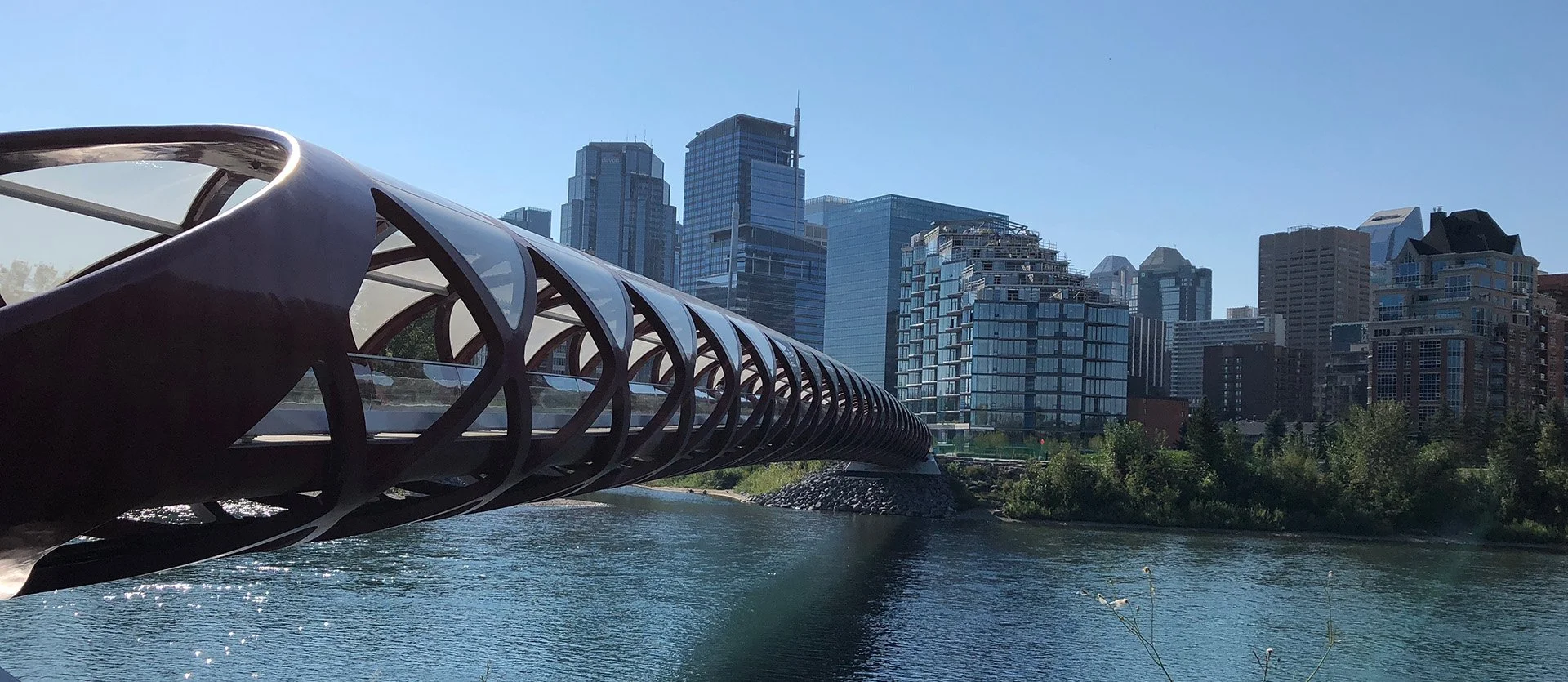
Peace Bridge, designed by Santiago Calatrava -- approved by council in 2008 in a 7-6 vote just seven days before the global economy was sent into a tailspin with U.S. banking giant Lehman Brothers collapsed, the bridge became a punching bag for critics. Just as quickly, the bridge became a source of pride for thousands of Calgarians who crowded onto the structure when it opened on March 24, 2012.
Delta Gardens, completed in 2018, was designed both as public art and as a functional way to safely move pedestrians and cyclists from the Peace Bridge onto the separate Promenade and Cycle Path. It features 12,000 brass survey monuments embedded in concrete.
ECCA’s mural at the Helipad (artist is Sarah Slaughter) – we commissioned this piece to mark our 30th Anniversary as a community association, and of course the lumberjacks are an homage to the Eau Claire and Bow River Lumber Company.
The federal government has decommissioned the helipad and the City is trying to reactivate it as a basketball court – but there are both federal and provincial hoops to jump through, so it’s not a sure thing.
Peace Park was developed to celebrate Canada’s 125th.
This sandstone memorial arch is 5 meters tall and was in the original facade of the Strathcona building (an office building located in what is now East Village), and the military parades used to pass the arch.
The arch was saved and stored for many years. It was first erected in Bridgeland as a memorial, but when the LRT station was built in 1985, it was dismantled rock by rock and moved here to remind us of the sacrifices of Canadian Soldiers.
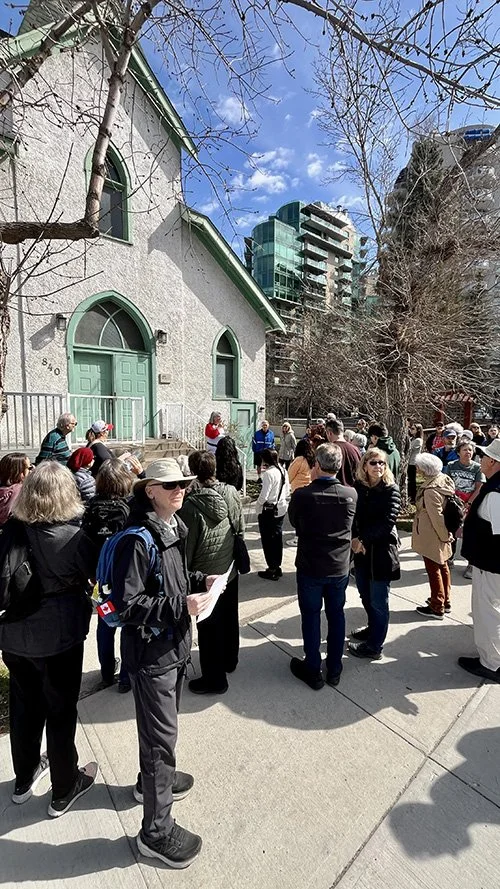
STOP SEVEN - TRINITY LUTHERAN CHURCH
Either walk here directly from Joe Phillips or from the Peace Park. In either case, you’ll stop at the NE corner of 3rd Avenue and 8th Street.
Founded in 1899, this was originally the “Norwegian Lutheran Church”, an ethnic congregation formed by the workers of the Eau Claire and Bow River Lumber Company
In those early years, the interested Norwegian Lutherans of the Eau Claire district organized themselves and began meeting in the members' homes. The Norwegian Lutheran Ladies' Aid eventually raised $2000 for the building of the church in 1924... A princely sum at that time.
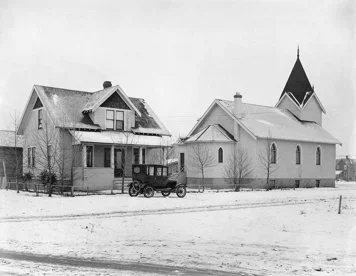
The photo we shared is undated but appears to be from the late 1920’s or early 1930’s,
The last pastor to live in the Manse left during the rough 1980’s period because it wasn’t safe to live there with his family.
3rd AVENUE DURING THE 1980’s
Back before the internet, the only way for sex workers to ply their trade was to literally walk the streets. Calgary’s original stroll was 7th Avenue, but when the LRT was built, the women were displaced.
Some went to Victoria Park, and some came here to 3rd Avenue. I first worked downtown in the early 1980’s in the Shell building – I was warned on the first day to always come and go through the 4th Avenue entrance. The men I worked with said they couldn’t step out on the 3rd Avenue side to get to their cars without being propositioned. There was a notorious strip club called the French Maid just down the block, and the women would use the Macs store (at 4th Avenue & 5th Street) to warm up and grab coffee.
STOP EIGHT – RIVER HALL
Due to construction in the spring of 2026, we looked at this from across the street, but it’s expected to be open by summer and is well worth some extra time.
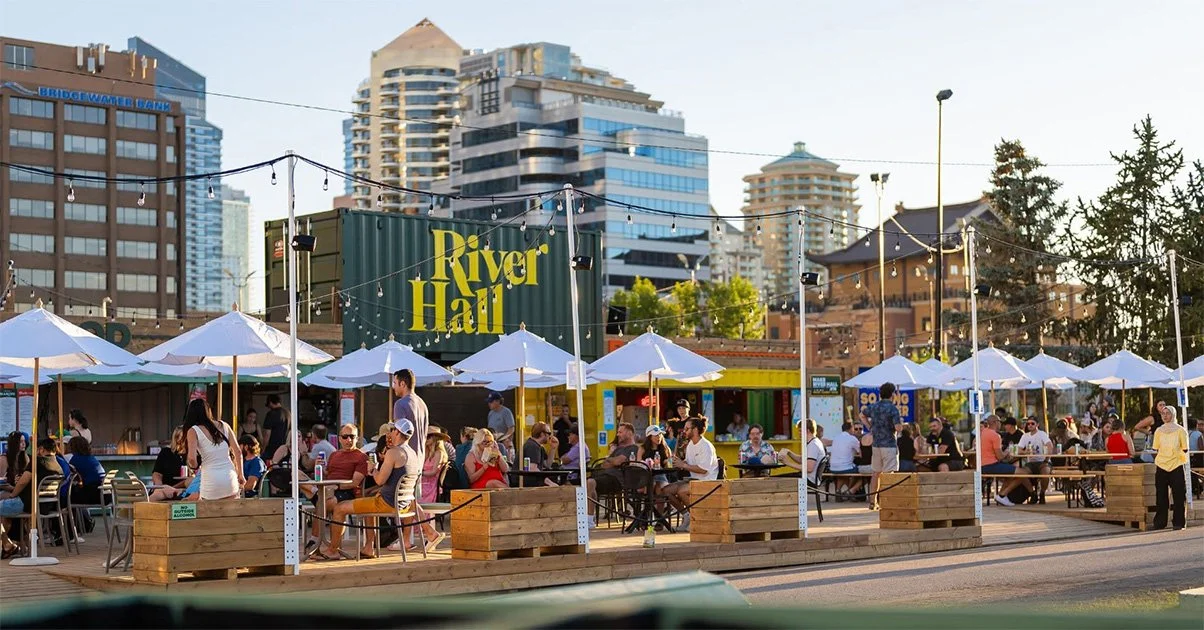
This was the site of the indoor Crystal Pool and outdoor skating rink from 1928 to approximately the mid-1960’s.
The River Walk West winning design plan (not funded yet) includes a swimming pool very close to this spot, which is an explicit call back to the old Crystal Pool.
This lot spent many decades as a parking lot, but in recent years the City has named it River Hall and activated it as a “pop-up paradise filling downtown spaces with energy and connection,” and it now has a development permit for a more permanent structure.
The events here have been enormously popular, and the city organizers have been very helpful and compliant with keeping the speakers pointed away from the residences behind us.
It’s been a great addition to the neighbourhood, and we encourage all of you to come out this summer to enjoy the scheduled events.
As we walk north on 8th Street, you’ll see that it’s recently been revitalized here at the north end. The project will carry on all the way to 17th Avenue on the south end and should be complete by 2029.
Turn left from 8th Street and walk along 4th Avenue to 5th Street
For years, the ECCA had to fight developers who wanted to fill our neighbourhood with office towers. The economic downturn of 2014 and then the WFH revolution resulting from the COVID pandemic has relieved us from that fight. Any development being proposed now is definitely residential or mixed-use.
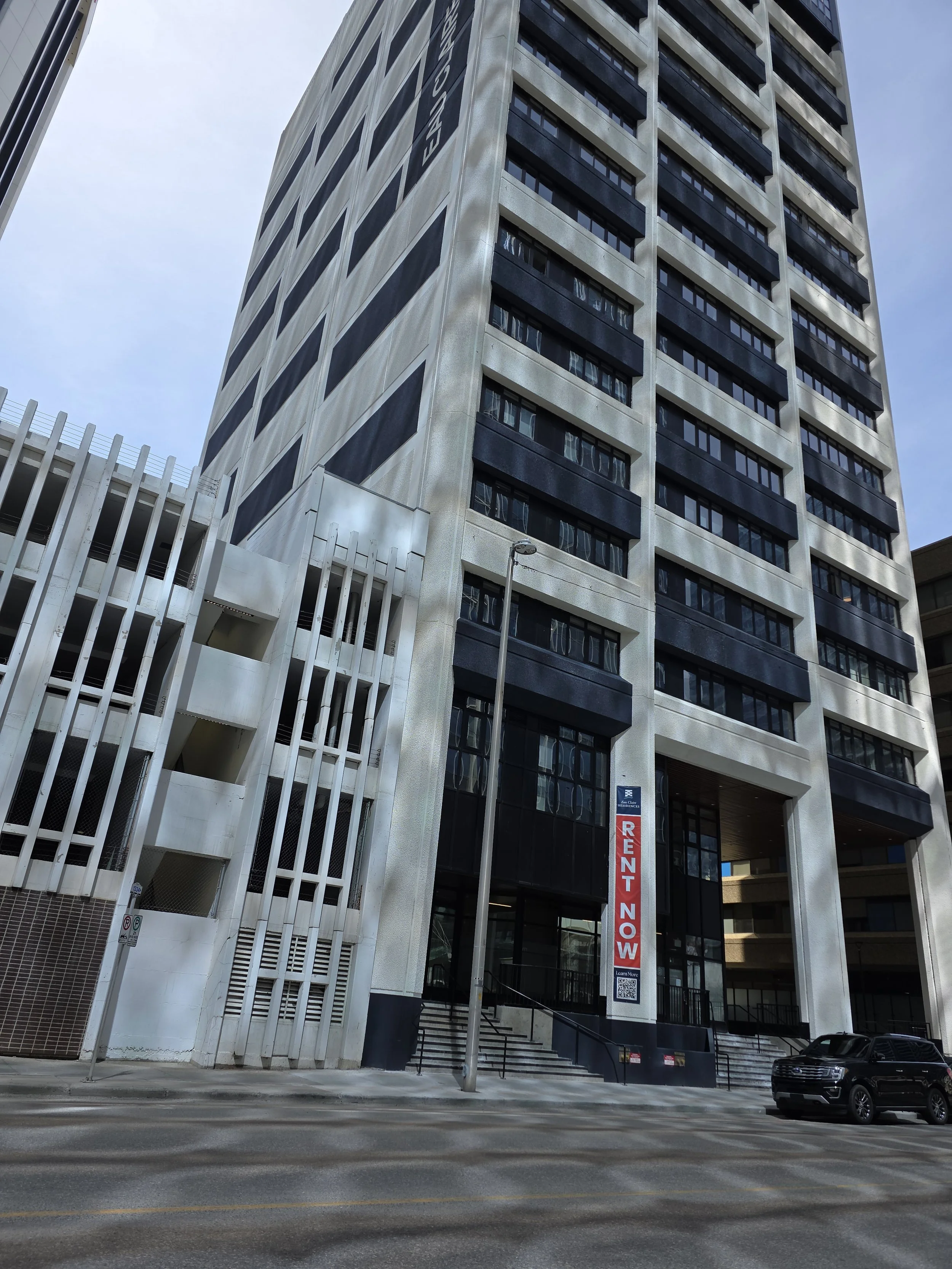
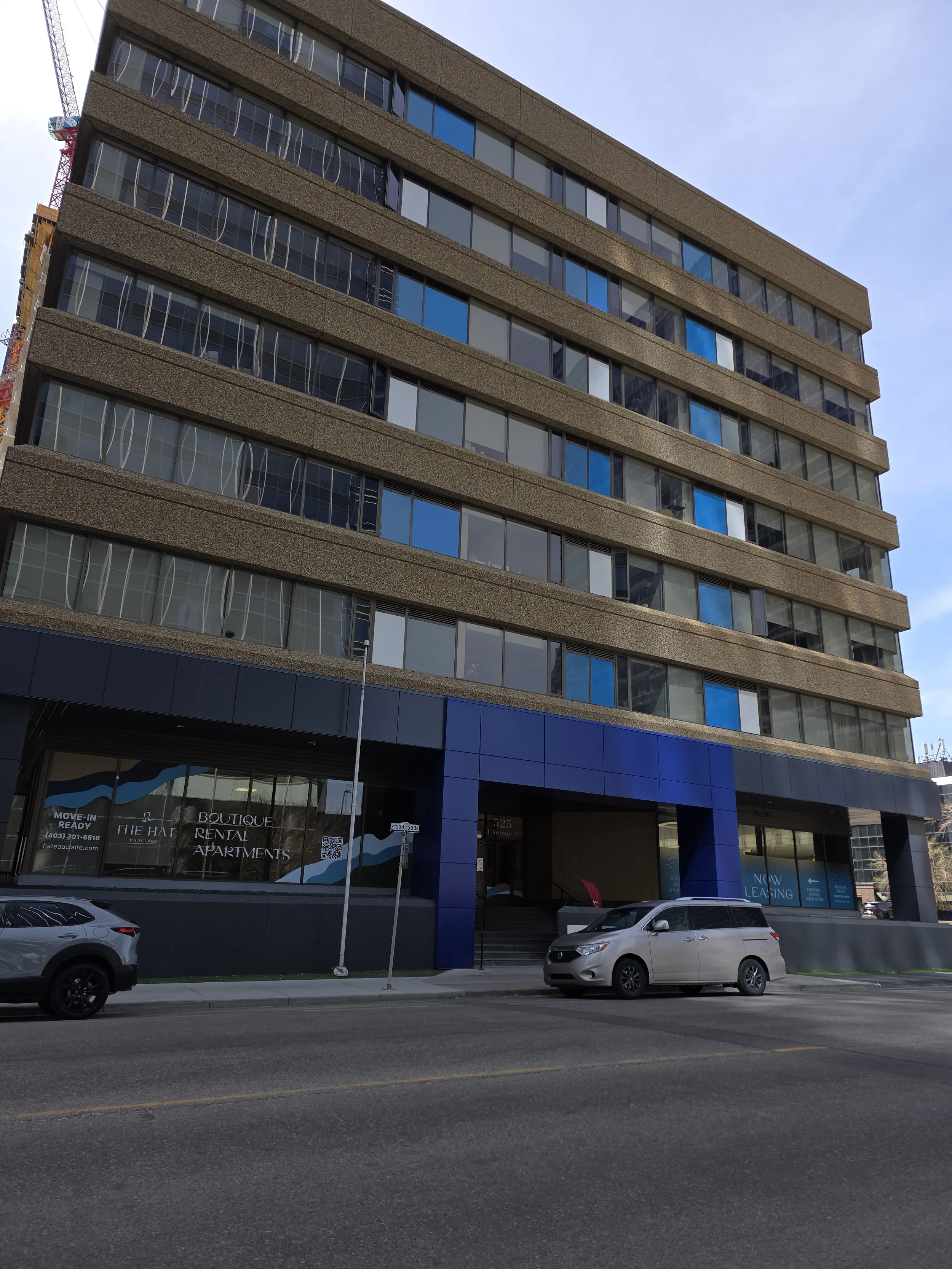
Facing a vacancy rate of over 30%, the City of Calgary created an incentive program to convert old, underused office buildings into residential buildings.
We’re going to see several successful reclamations over the next few blocks.
833 – 4th Ave Element by Westin Hotel (office to hotel conversion)
744 – 4th Ave – the Lofts (office to residential conversion)
700 block -- the new Trico development
We don’t have a development permit yet, but the plans we’ve seen envision a 10 to 15-storey mixed-use development with commercial on the lower floors and residential above.
600 block - the Westley Hotel (office to hotel conversion – dates from before the incentive program; they were just creative thinkers)
Turn right onto 5th Street, and you’ll see Kings on Fourth (currently under construction). From their webpage:
Kings on Fourth will set the benchmark for luxury in Calgary's residential condominium market and hotel industry. This 45-storey mixed-use development will feature a truly world-class lobby never before seen in Calgary, 250,000 square feet of Class A office space, which will be available for purchase, an internationally acclaimed four- or five-diamond luxury hotel and 120 luxuriously appointed residences above.
Spectacular views, ultra-luxurious finishes and an optimal location will define LaCaille's most ambitious urban development.
Cross 5th Street & 3rd Avenue to get a good look at The Residences and The Hat (office-to-residential conversions). These two buildings have added 195 and 87 units of residential accommodation, respectively to our neighbourhood.
As you’ve seen, the Office to Residential program has been very successful, but it isn’t very transparent. I wasn’t able to answer any of the questions people had about how much it costs to redevelop these properties or how much each property received from the city. Each building has a different developer and a confidential contract with the City of Calgary.
Continue along 3rd Avenue to 3rd Street and turn south to the Plaza
FINAL STOP – OLYMPIC ARCH – we’ve come a full circle
This arch was one of the structures constructed in Calgary to celebrate the 1988 Olympic Games.
Our Olympics were unique at the time because of the way ordinary citizens were deeply involved as volunteers. Jane Jacobs would have been proud! Citizen participation in festival-like activities surrounding the Games, such as in the downtown core on Stephen Avenue, at the medal ceremonies at Olympic Plaza, at neighbourhood gatherings and through a school-based Olympic education program, involved local residents in a way that later host cities attempted to emulate.
It is this sense of an urban festival which transformed the Olympics from an elitist event and created warm memories that people resident in the city at the time will never forget.
Although it was the most expensive Olympics ever held to that date, there was a net surplus from record-breaking sponsorship and television revenues that would give the organizing committee the power to maintain its world-class sports facilities for many years to come. A large part of this was the negotiated 16-day time span for the event instead of the usual 12.
In the future, these facilities would become the basis not only for Calgary activities and events, but for the training of Canada’s Olympic athletes as well as other sports professionals.
During the difficult 80s, the Games raised morale, provided jobs constructing the sites and boosted the tourism economy of Calgary and the Rockies.
Green Line
Because of time constraints and knowing that the Green Line staff were also doing Jane’s Walks, this topic wasn’t on my tour. But I did get questions about them. Please see the information on our website.